Tarot's Living Traditions
Seventy-eight cards, countless traditions -- how centuries of art, occultism, and folk practice produced a divinatory system that means different things to nearly everyone who picks it up.
A tarot deck is 78 cards. That much is consistent. But nearly everything else -- how those cards are illustrated, how they are interpreted, and what they are believed to do -- varies dramatically depending on which tradition a practitioner inherits, adopts, or invents. Tarot is not a single system. It is a family of systems, shaped by centuries of cross-pollination between art, occultism, psychology, and folk practice. Understanding the major branches helps make sense of why two readers can look at the same card and arrive at entirely different conclusions.
The Deck Itself
The 78-card structure has remained remarkably stable since the fifteenth century: 22 Major Arcana (the trumps, from The Fool through The World) and 56 Minor Arcana divided into four suits, each containing ten numbered cards (pips) and four court cards. But stability of structure has not meant uniformity of design.
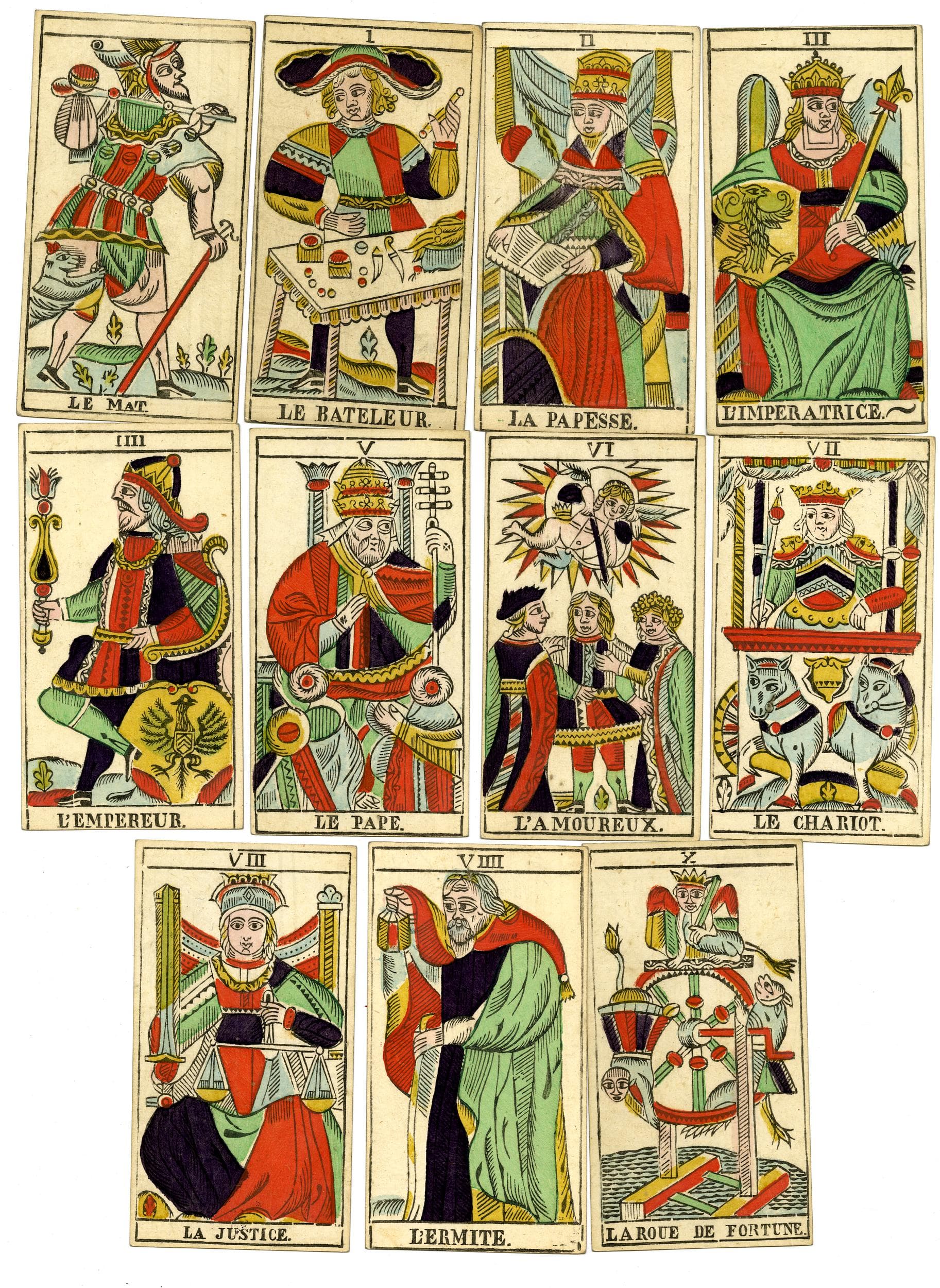
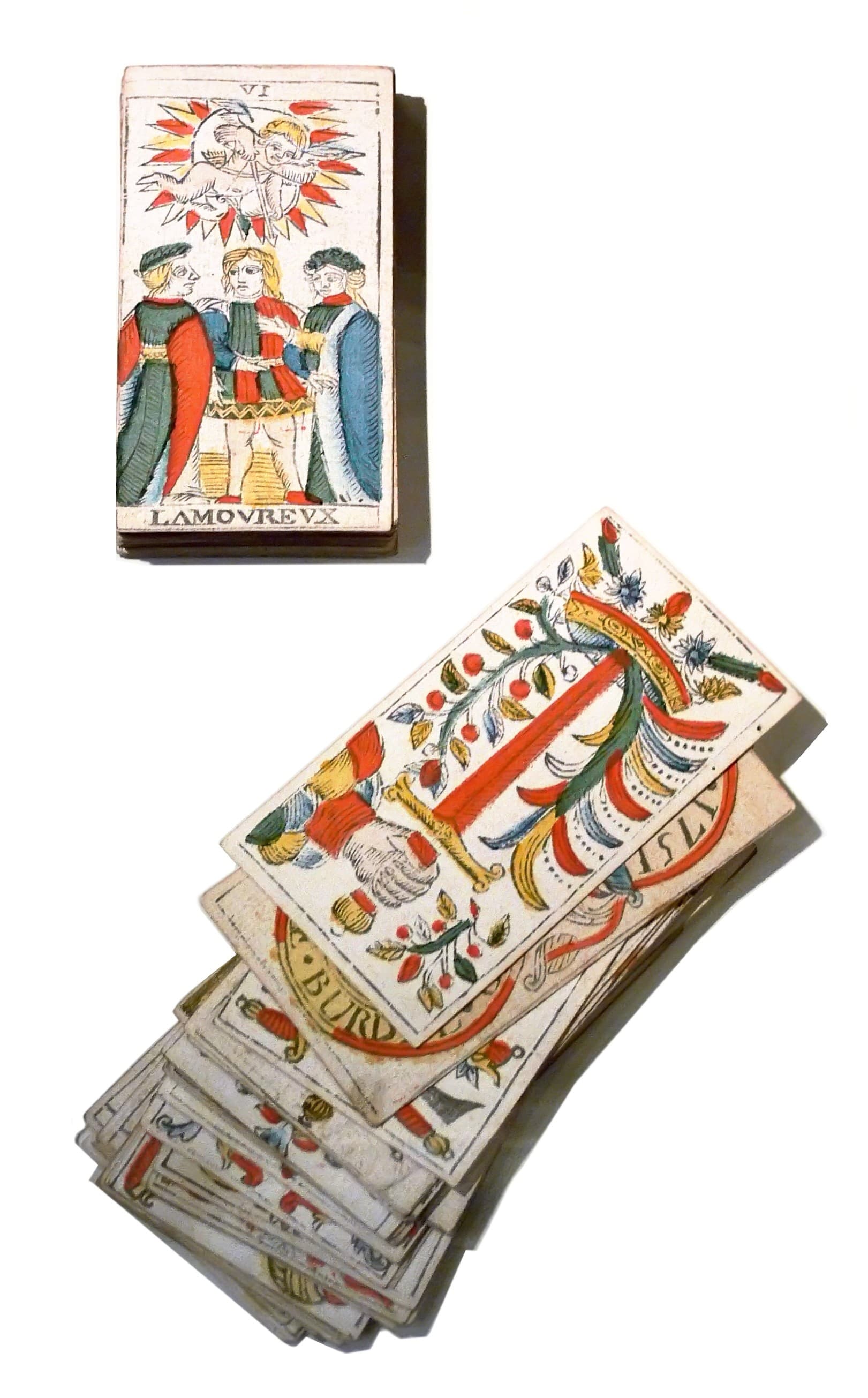
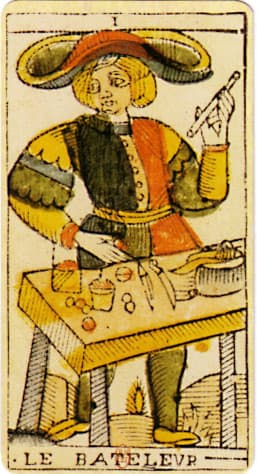
The Tarot de Marseille, codified by French cardmakers in the seventeenth and eighteenth centuries, presents the Minor Arcana as unillustrated pip cards -- geometric arrangements of cups, swords, coins, and batons with no narrative scenes. Reading these cards requires memorized meanings or numerological reasoning; the Six of Swords is simply six swords on a card. The Majors, by contrast, carry vivid allegorical imagery that has remained largely consistent across Marseille-pattern decks for over three hundred years.
The Rider-Waite-Smith deck (RWS), published in 1909, broke decisively from this tradition. Designed by Arthur Edward Waite with illustrations by Pamela Colman Smith -- both members of the Hermetic Order of the Golden Dawn -- the RWS gave every Minor Arcana card a unique pictorial scene. The Six of Swords became a figure poling a boat across troubled water, immediately suggesting transition and departure. This innovation made the deck far more accessible to intuitive readers and cemented it as the most widely used tarot deck in the English-speaking world.
The Thoth Tarot, painted by Lady Frieda Harris under the direction of Aleister Crowley between 1938 and 1943 but not published until 1969, took a different path. Its imagery is densely layered with astrological, Kabbalistic, and alchemical symbolism. Crowley renamed several Major Arcana -- Strength became Lust, Temperance became Art, Judgement became The Aeon -- reflecting his own esoteric philosophy. The Thoth deck demands study; it rewards practitioners willing to engage with its elaborate correspondences but resists casual use.
Hundreds of contemporary decks now exist, from minimalist redesigns to culturally specific reinterpretations. Most preserve the 78-card framework while varying widely in art style, symbolism, and thematic emphasis.
Schools of Interpretation
How a reader assigns meaning to a card depends heavily on their interpretive tradition.
The Golden Dawn / Kabbalistic school treats tarot as a map of esoteric cosmology. Each Major Arcana card corresponds to a Hebrew letter and a path on the Kabbalistic Tree of Life, connecting the ten sephiroth (divine emanations). The Minor Arcana pips map to specific sephirotic positions within their suit's element. This system, elaborated by Golden Dawn members like S.L. MacGregor Mathers and later systematized by Waite and Crowley, treats a reading as an exercise in navigating a structured metaphysical framework. Astrological decans, elemental dignities, and planetary correspondences all factor into interpretation.
The Jungian / archetypal school emerged in the mid-twentieth century, drawing on Carl Jung's concept of the collective unconscious. The Major Arcana represent universal archetypes -- the Magician as will and agency, the High Priestess as the threshold of the unconscious, the Tower as sudden disruption of rigid structures. Practitioners in this tradition often use tarot for psychological self-exploration, shadow work, and individuation rather than predictive divination. The cards function as mirrors, surfacing unconscious material through the reader's projective response to the imagery.
The intuitive / modern school dispenses with fixed correspondences altogether. Readers in this tradition emphasize personal resonance, visual free-association, and the emotional response a card provokes in the moment. No single book or system is authoritative; meaning emerges from the interaction between reader, querent, and image. This approach has gained significant ground with the proliferation of indie and self-published decks, many of which include companion guides that encourage readers to develop their own interpretive vocabulary.
These schools are not mutually exclusive. Many working readers blend elements freely -- consulting elemental dignities for one spread and relying on pure intuition for the next.
Reading Methods
The physical layout of cards in a reading -- the spread -- provides structure for interpretation by assigning positional meanings.
The Celtic Cross is the most widely recognized spread, typically using ten cards arranged in a cross-and-staff pattern. Its origins are often attributed to Arthur Edward Waite, who described a version of it in The Pictorial Key to the Tarot (1911), though similar cross-shaped layouts may predate him. Positions in the Celtic Cross typically represent the querent's current situation, obstacles, conscious and unconscious influences, the recent past, the near future, and an outcome. Its complexity makes it a staple for detailed readings but can be unwieldy for focused questions.
Three-card draws -- commonly mapped to past, present, and future, or to situation, action, and outcome -- offer a simpler framework. Their brevity makes them popular for daily practice and for readers who prefer concise, focused readings.
Single-card pulls strip the process down further, offering a point of meditation or a thematic anchor for the day. This method has gained particular traction on social media, where a daily card becomes shareable content.
Beyond positional spreads, some readers practice narrative or free-form reading, laying cards without predetermined positions and interpreting them as a visual story. Cards interact with their neighbors through imagery, color, and directional cues rather than through assigned slot meanings. This approach is more common among readers influenced by the intuitive school and is particularly well-suited to Marseille-style decks, where the unillustrated pips encourage pattern recognition across the layout.
Regional and Cultural Variation
Tarot's roots are Italian. The game of tarocchi, played with trump cards added to a standard suit deck, appeared in northern Italian courts in the early fifteenth century -- likely originating in Milan or Bologna. Remarkably, tarocchi survives as a card game in parts of Italy, France, and Central Europe today, entirely separate from any divinatory use. Italian game decks often use regional suit signs (coins, cups, swords, and batons) and follow trick-taking rules that have nothing to do with fortune-telling.
French cartomancy -- card divination using standard playing cards -- developed as a parallel tradition. The Lenormand system, named after the nineteenth-century French fortune-teller Marie Anne Lenormand (though the deck attributed to her was published after her death), uses a separate 36-card deck with its own imagery and reading grammar. Lenormand is not tarot, but the two traditions frequently cross-pollinate, and the French cartomantic emphasis on card combinations has influenced how some tarot readers interpret pairs and clusters.
In Latin America, tarot blends with local spiritual traditions. Mexican tarotistas often integrate Catholic iconography, and tarot reading is sometimes practiced alongside curanderismo (folk healing). In Brazil, tarot has been absorbed into eclectic spiritual communities that also draw on candomble, astrology, and numerology.
East Asian adoption of tarot has grown substantially in recent decades. Japan has a well-established tarot culture, with domestically designed decks, dedicated magazines, and professional certification programs. South Korean and Taiwanese tarot communities are similarly active, often blending Western tarot structure with local aesthetic sensibilities and philosophical frameworks.
The internet and social media have accelerated this global spread, allowing practitioners in any region to access teachings, decks, and communities that were previously geographically bounded. The result is a practice simultaneously more standardized (the RWS framework dominates online) and more diverse (niche traditions find audiences they never could have reached locally) than at any point in its history.
Further Reading
- Tarot -- Wikipedia's overview of tarot history, from fifteenth-century Italian card games through modern divinatory use.
- Tarot de Marseille -- A detailed account of the Marseille pattern's development and the major cardmakers who defined it.
- The World of Playing Cards -- An encyclopedic reference on card history, including extensive sections on tarot decks, Marseille variants, and regional traditions.
- Hermetic Order of the Golden Dawn -- Background on the esoteric society whose members created both the Rider-Waite-Smith and Thoth decks.
- Thoth Tarot Deck -- The history and design philosophy of Crowley and Harris's densely symbolic deck.