A Brief History of Tarot
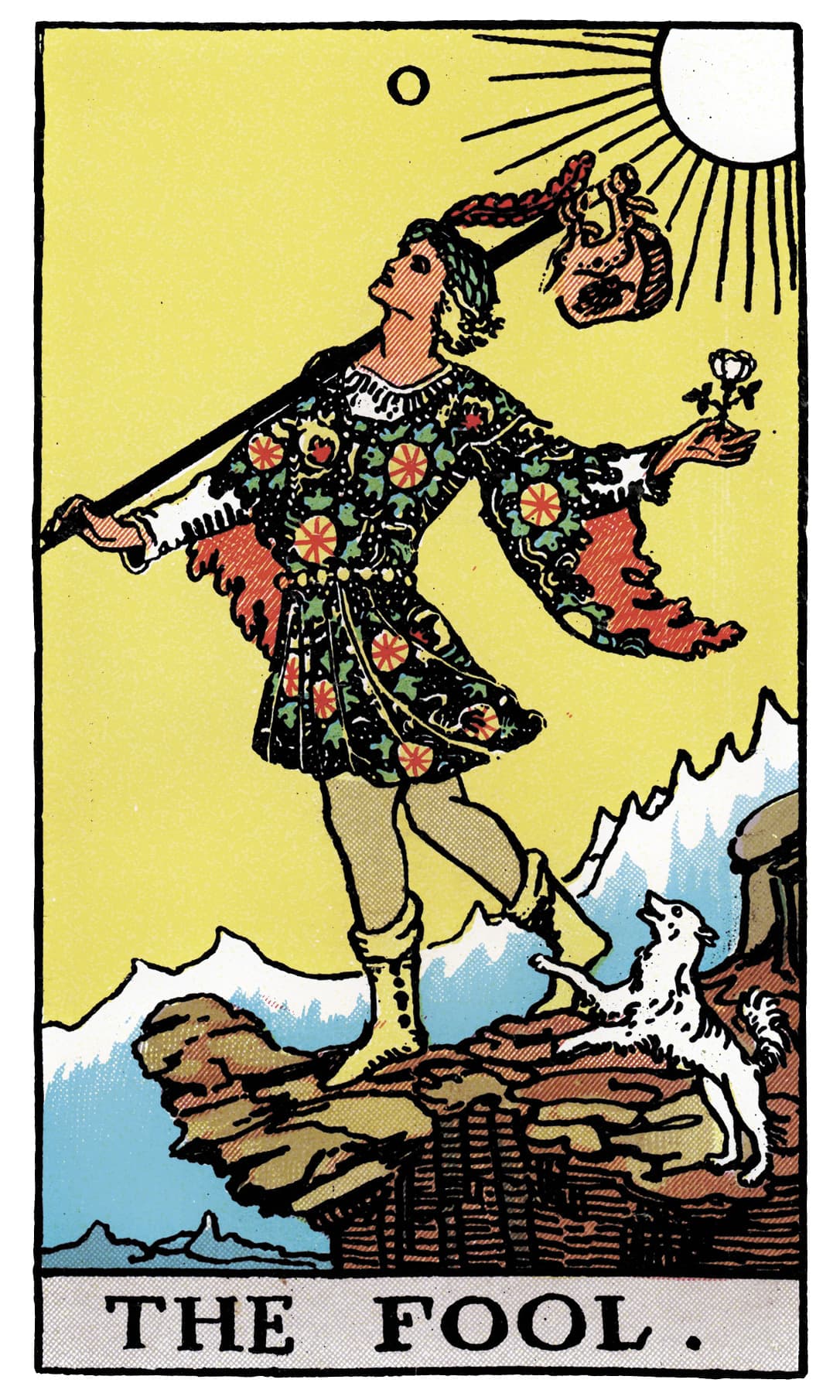
From gambling tables in Renaissance Milan to TikTok spreads — the strange, true journey of 78 painted cards.
Most people encounter tarot the same way: a spread of illustrated cards on a table... an ecclectic soul endeavoring to read the future... It is a powerful image, and it has shaped the popular understanding of tarot for over two centuries. But the actual history of these cards has almost nothing to do with divination — at least not at first. Tarot began as a card game, evolved through centuries of cultural reinvention, and arrived at its current identity through a series of creative misreadings, artistic breakthroughs, and genuine spiritual seeking. The story is stranger and more interesting than the myth.
Playing Cards Arrive in Europe
The story of tarot starts before tarot itself, with the arrival of playing cards in Europe during the late fourteenth century. The most likely ancestors were Mamluk game cards from Egypt, which featured four suits — cups, coins, swords, and polo sticks — with numbered pip cards and three court cards per suit. These decks circulated through Mediterranean trade networks, reaching the Iberian Peninsula and the Italian city-states by the 1370s. The earliest known European reference to playing cards dates to 1367, in a document from Bern, Switzerland.
European cardmakers adapted the Mamluk designs to local tastes. Polo sticks, unfamiliar in Europe, became batons or staves. Court cards were redrawn with European figures. By the early fifteenth century, playing cards were a fixture of daily life across Italy, Spain, France, and German-speaking lands. There was nothing mystical about them.
Italian Trick-Taking Games and the Trumps
The leap from ordinary playing cards to what would eventually be called tarot happened in northern Italy around the 1440s. Wealthy families in Milan, Bologna, and Ferrara commissioned elaborate hand-painted decks that added a fifth suit of illustrated cards to the standard four. These extra cards were known as trionfi — triumphs, or trumps — and they functioned as a permanent trump suit in trick-taking games. The game itself was called trionfi, and later tarocchi, the Italian word from which "tarot" derives.
The earliest surviving examples include the Visconti-Sforza decks, created for the Duke of Milan's family around 1440 to 1450. These lavish, gold-leafed cards depicted allegorical figures: the Pope, the Emperor, the Wheel of Fortune, the World.
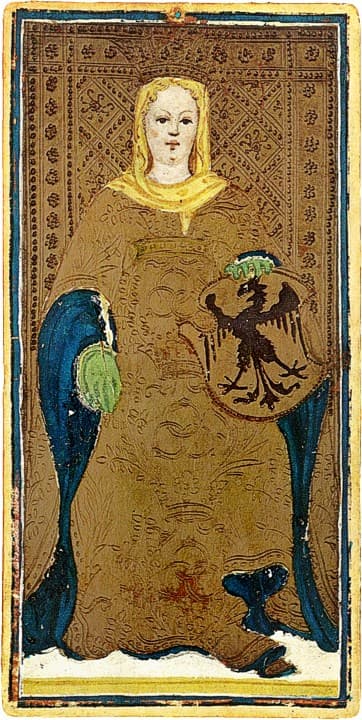
The 22 trump cards mapped loosely onto a hierarchy of medieval values and cosmological ideas, but their purpose was gameplay, not prophecy. For roughly three centuries, tarocchi remained exactly what it appeared to be — a card game, popular across Italy and eventually France, with no occult associations whatsoever.
The Occult Turn
The transformation of tarot from parlor game to esoteric tool happened abruptly and is traceable to a single publication. In 1781, a French clergyman and amateur scholar named Antoine Court de Gebelin published the eighth volume of his encyclopedic work Le Monde Primitif. In it, he declared that the tarot trumps were not medieval European inventions at all, but surviving fragments of the Book of Thoth, an ancient Egyptian text of divine wisdom. Court de Gebelin offered no real evidence for this claim — Egypt's hieroglyphics had not yet been deciphered, and his analysis relied on imaginative symbolism rather than historical scholarship. But the idea was irresistible. It reframed a common deck of game cards as a lost artifact of ancient knowledge, and it landed in a culture already fascinated by Egypt and the occult.
Within a few years, a Parisian fortune-teller named Jean-Baptiste Alliette — working under the reversed pseudonym Etteilla — seized on Court de Gebelin's theory and ran with it. Around 1785, Etteilla published one of the first known guides to tarot divination, assigning divinatory meanings to each card. By 1789, he had produced the first deck designed specifically for occult use rather than card games. Etteilla's innovations laid the groundwork for everything that followed: the idea that each card carried a fixed symbolic meaning, that spreads and positions mattered, and that tarot could serve as a tool for accessing hidden knowledge.
The occult interpretation of tarot continued to develop throughout the nineteenth century. Eliphas Levi, the influential French occultist, linked the 22 trump cards to the 22 letters of the Hebrew alphabet in the 1850s, weaving tarot into the Kabbalistic tradition. The Hermetic Order of the Golden Dawn, a British secret society founded in 1888, incorporated tarot deeply into its system of ceremonial magic. By the end of the century, tarot's identity as a game had been almost entirely eclipsed by its new identity as a tool of esoteric practice.
Rider-Waite-Smith and the Modern Reading Deck
The tarot deck that most people recognize today — the one sold in bookstores and referenced in pop culture — is the Rider-Waite-Smith deck, first published in 1909 by the London publisher Rider & Company. It was designed by Arthur Edward Waite, a British mystic and Golden Dawn member, and illustrated by Pamela Colman Smith, a British-American artist and fellow member of the order.
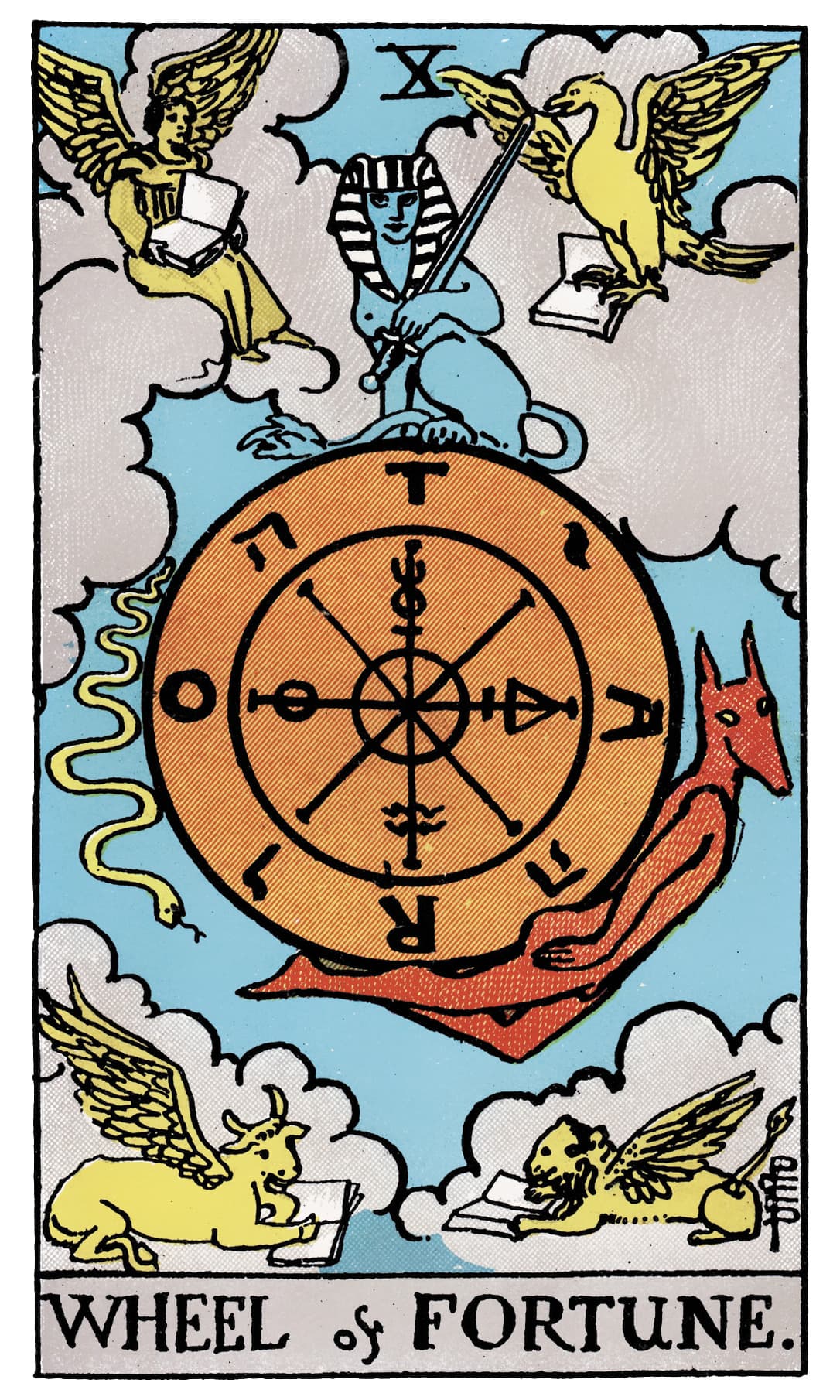
Smith's contribution was the deck's true revolution. Previous tarot decks, including the widely used Tarot de Marseille, depicted the 56 minor arcana cards — the numbered and court cards of the four suits — as simple pip arrangements: five swords, seven cups, ten coins. Smith painted a unique narrative scene onto every single card in the deck, giving each one a visual story that could be intuitively interpreted without specialized knowledge. The Ten of Swords showed a figure lying face-down with ten blades in his back. The Three of Cups depicted three women dancing together in celebration. These images made the deck radically more accessible. A reader no longer needed to memorize abstract correspondences; the pictures themselves suggested meaning.
Despite the deck's enormous influence, Smith received a one-time flat payment for her work and no royalties. She died in relative obscurity in 1951. The deck was known for decades simply as the "Rider-Waite," erasing her contribution. In recent years, scholars and practitioners have pushed to restore her name, and the designation "Rider-Waite-Smith" — or simply the "Smith-Waite" — has become increasingly standard.
Tarot Today
Tarot experienced a significant revival during the counterculture movements of the 1960s and 1970s, when interest in Eastern philosophy, astrology, and alternative spirituality surged across the Western world. The cards fit naturally into a moment that valued personal exploration, symbolic thinking, and resistance to institutional authority. New decks proliferated, drawing on feminist, Jungian, Indigenous, and countless other frameworks.
In the twenty-first century, tarot has moved further into the mainstream than at any point in its history. It appears in therapy practices as a projective tool for self-reflection, similar to how a therapist might use open-ended questions or guided imagery. Secular practitioners describe the cards not as fortune-telling devices but as mirrors — structured prompts for examining assumptions, identifying patterns, and articulating feelings that resist direct expression. The randomness of a card draw, on this view, is the point: it creates a space for interpretation that is guided by the reader's own psychology rather than any external force.
Meanwhile, tarot has become a thriving visual and commercial culture. Independent artists release new decks constantly, reimagining Smith's original illustrations through every conceivable aesthetic and cultural lens. Tarot content saturates social media. The cards have become a shared symbolic vocabulary — a set of images that millions of people recognize and use to think about their lives, whether or not they believe in anything supernatural.
Six centuries after a duke in Milan commissioned a set of painted trump cards for an afternoon game, tarot continues to evolve. Its history is a reminder that symbols do not belong permanently to any single use. A game can become a spiritual practice. A spiritual practice can become a creative medium. And a set of images, passed through enough hands and enough centuries, can accumulate more meaning than any single origin story can contain.
Further Reading
- Tarot - Wikipedia — Comprehensive overview of tarot's history, structure, and cultural significance across the centuries.
- The Visconti-Sforza Tarot Deck (The Morgan Library & Museum) — High-resolution images and scholarly context for one of the oldest surviving tarot decks.
- Tarot Card Reading - World of Playing Cards — A collector-oriented history of tarot from its origins in card games to modern divinatory use.
- Pamela Colman Smith - Wikipedia — The life and artistic legacy of the woman who illustrated the most influential tarot deck in history.
- Mamluk Cards - Wikipedia — The Egyptian playing cards that are widely considered the direct ancestors of European tarot.