Tarot: A Cultural and Intellectual History
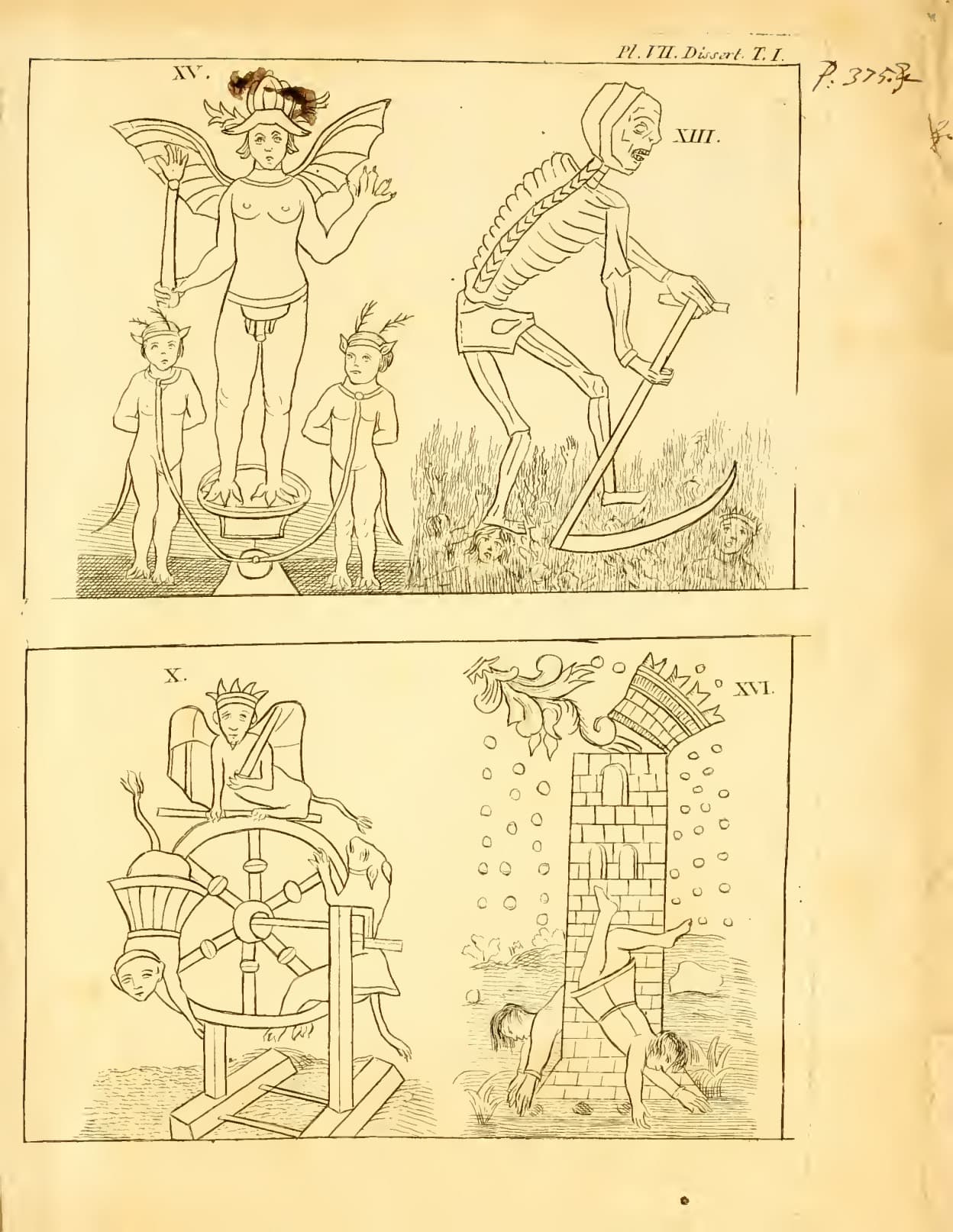
How a Renaissance card game acquired an Egyptian origin myth, a Kabbalistic superstructure, and a century of scholarly dispute.
Few artifacts sit so uncomfortably between the scholarly and the popular as tarot. The same 78 cards serve simultaneously as the subject of rigorous archival research and as a fixture of New Age bookshops. That dissonance reflects a genuine break in the historical record — a point where documented fact gives way to invented tradition, and where the effort to disentangle the two has itself become a significant chapter in intellectual history.
Documentary Evidence: The Trionfi Decks
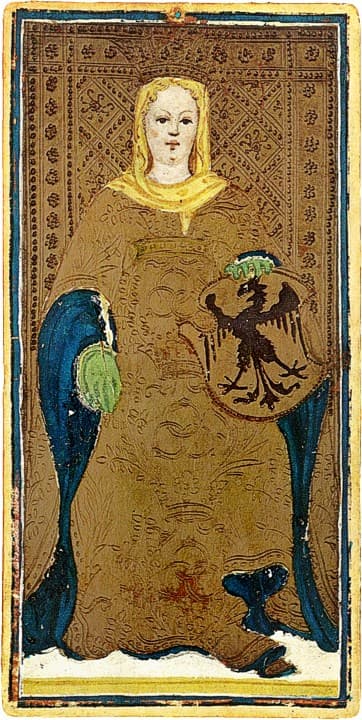
The earliest firm evidence for tarot cards places them in the courts of northern Italy during the 1440s. The most celebrated survivors are the Visconti-Sforza decks, a group of hand-painted luxury cards commissioned by the ruling families of Milan. Art historians generally attribute the finest of these — the Pierpont Morgan-Bergamo deck — to Bonifacio Bembo, dating production to roughly 1451 to 1453. Surviving cards are divided among the Pierpont Morgan Library in New York, the Accademia Carrara in Bergamo, and a private collection.
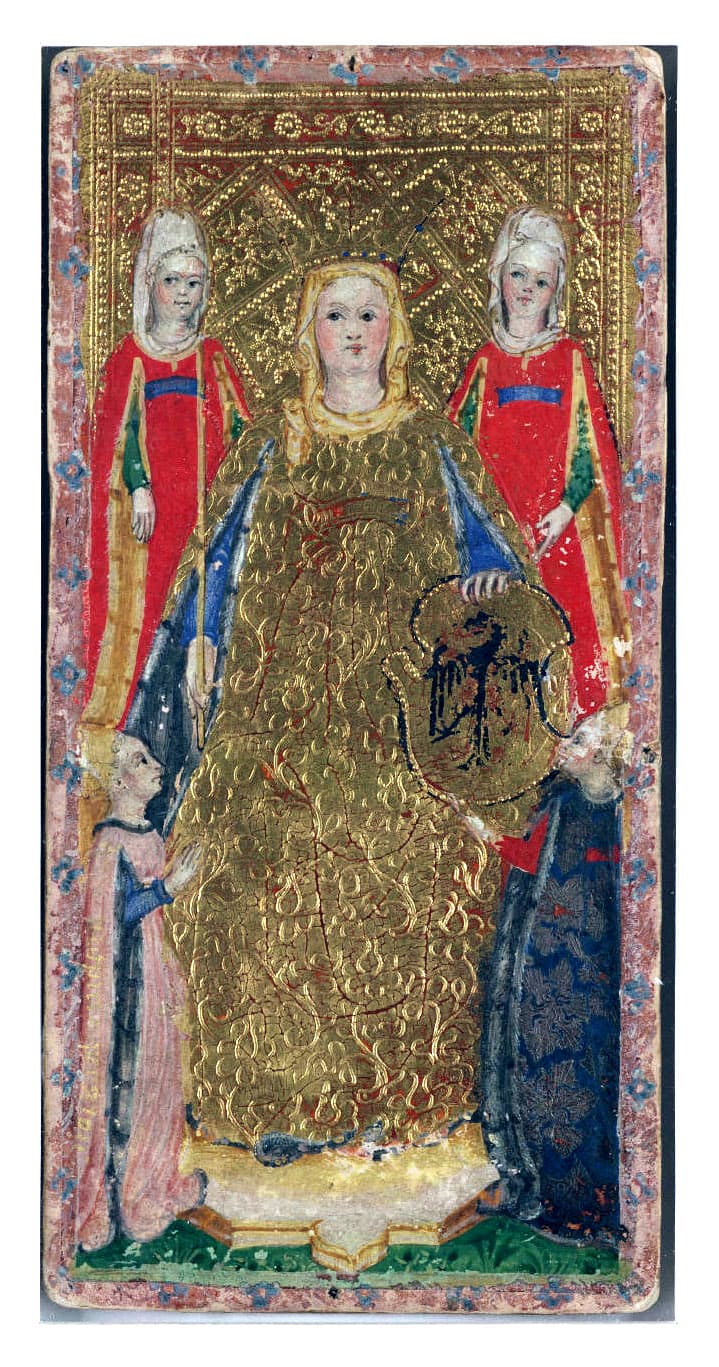
Another significant survivor is the Cary-Yale Visconti deck, now held at Yale University's Beinecke Rare Book and Manuscript Library, which preserves some of the earliest known tarot imagery in its original painted form.
Court records from Ferrara provide independent corroboration. A 1442 account-book entry from the Este court references payment for a deck of carte da trionfi — triumph cards — confirming both the name and the existence of the distinctive fifth suit of allegorical trumps that distinguishes tarot from ordinary playing cards. The Sermones de Ludo cum Aliis, a moralizing text likely composed in the 1470s or 1480s, offers one of the earliest descriptions of the trump sequence and its symbolic content, treating each figure as an occasion for ethical commentary. Across these sources, a consistent picture emerges: trionfi was a trick-taking card game played by the Italian elite, its trumps drawn from the conventional imagery of medieval allegory — the Wheel of Fortune, the Pope, the Last Judgment. Nothing in the fifteenth-century record connects these cards to divination, mysticism, or any tradition older than the Italian Renaissance itself.
The Mamluk Hypothesis
If the trumps are a fifteenth-century Italian invention, the four-suited deck they were grafted onto has a longer and more contested genealogy. Playing cards appeared in Europe abruptly during the 1370s, with references surfacing in Florence, Basel, and the Iberian Peninsula within a few years of each other. The leading hypothesis traces their origin to the Mamluk sultanate of Egypt. A substantially complete Mamluk deck, now held at the Topkapi Palace Museum in Istanbul and generally dated to the fifteenth century, displays a four-suit structure parallel to the Italian one: cups, coins, swords, and polo sticks — the last unfamiliar in Europe, where it became batons or staves. Each suit contained ten pip cards and three court cards (malik, na'ib malik, and thani na'ib), a hierarchy that prefigures the European king-queen-knight arrangement.
The transmission mechanism remains unclear. Trade routes and Mediterranean commerce offer plausible channels, but no single document records the moment playing cards crossed from the Islamic world into Christian Europe. The Mamluk hypothesis, while widely accepted, rests on structural and circumstantial evidence rather than a documented chain of custody.
Court de Gebelin and the Invention of Esoteric Tarot
For roughly three centuries after its appearance, tarot accumulated no occult reputation. That changed in 1781, when Antoine Court de Gebelin, a French Protestant pastor and speculative antiquarian, published the eighth volume of his encyclopedia Le Monde Primitif. In an essay on the trumps, Court de Gebelin declared them surviving pages of the Book of Thoth, a repository of ancient Egyptian priestly wisdom. The claim was unsupported — the Rosetta Stone would not be decoded until 1822, and his readings relied on fanciful etymologies and wishful iconographic parallels — but it proved enormously generative, reframing a common card game as a veiled transmission of sacred knowledge.
The practical consequences followed quickly. Jean-Baptiste Alliette, a Parisian seed merchant working under the reversed pseudonym Etteilla, became arguably the first professional tarot cartomancer. By 1789 he had published a purpose-built divinatory deck and a systematic method for reading card spreads — innovations that established the basic architecture of tarot divination as it is still practiced. Where Court de Gebelin supplied the origin myth, Etteilla built the applied discipline.
Occult Institutionalization
The nineteenth century saw tarot absorbed into increasingly elaborate esoteric systems. In 1856, Alphonse Louis Constant — writing as Eliphas Levi — published Dogme et Rituel de la Haute Magie, mapping the 22 tarot trumps onto the 22 letters of the Hebrew alphabet and binding tarot to Kabbalistic tradition. Levi's correspondence system was speculative and internally inconsistent, but it gave later occultists a structural principle for integrating tarot with other symbolic traditions.
The most consequential inheritors of that principle were the founders of the Hermetic Order of the Golden Dawn, established in London in 1888 by William Wynn Westcott and Samuel Liddell MacGregor Mathers. The Golden Dawn synthesized tarot with astrology, Kabbalah, Enochian magic, and alchemical symbolism into a single initiatory curriculum. Tarot was no longer just a divinatory tool; it was a mnemonic map of the entire Western esoteric tradition.
Out of this milieu came the deck that would define modern tarot. In 1909, Arthur Edward Waite commissioned Pamela Colman Smith — a British-American artist and fellow Golden Dawn initiate — to illustrate a new deck published by Rider & Company. Smith's contribution was to paint full narrative scenes on all 78 cards, including the minor arcana that earlier decks had depicted as simple pip arrangements, making tarot accessible to readers without esoteric training. It became the most widely reproduced deck in history. Smith received a flat fee and no royalties; her name was omitted from the title for decades.
Historiographic Debates
The scholarly study of tarot as a historical rather than esoteric object is dominated by the work of the philosopher Michael Dummett. His monumental The Game of Tarot (1980) approached the subject from the perspective of game history, documenting the rules, regional variations, and social contexts of tarot card games across Europe from the fifteenth century onward. Dummett's central intervention was methodological: he insisted on treating the documentary record as primary and the esoteric tradition as a demonstrably late invention, arguing that the occult interpretation had no connection to the cards' actual origins and had distorted virtually all prior scholarship.
Dummett was unsparing: he regarded the Egyptian-origin narrative as fabrication and the Kabbalistic correspondences as arbitrary impositions. His later collaborations with Ronald Decker and Thierry Depaulis — notably A Wicked Pack of Cards (1996) and A History of the Occult Tarot (2002) — extended the archival project, tracing the textual genealogy through which Court de Gebelin's speculation hardened into received wisdom.
The current state of tarot scholarship reflects Dummett's intervention without fully resolving it. Historians of games and material culture broadly accept his framework: tarot originated as a card game, the occult tradition is an eighteenth-century invention, and claims of ancient lineage lack evidentiary support. But scholars of Western esotericism — figures like Wouter Hanegraaff — have complicated the picture by arguing that the cultural reality of the occult tradition matters independently of its historical accuracy. A practice does not need an ancient pedigree to be historically significant. The tension between these perspectives — between origin and reception, between what tarot was and what it became — remains the most productive fault line in the field.
Further Reading
- Michael Dummett, The Game of Tarot: From Ferrara to Salt Lake City (Duckworth, 1980). The foundational work of modern tarot scholarship, treating the cards primarily as gaming implements with a documented social history.
- Ronald Decker, Thierry Depaulis, and Michael Dummett, A Wicked Pack of Cards: The Origins of the Occult Tarot (St. Martin's Press, 1996). A detailed archival investigation of how tarot acquired its esoteric associations from Court de Gebelin onward.
- The Visconti-Sforza tarot deck article on Wikipedia provides a thorough overview of the surviving cards, their attribution, and the institutions that hold them.
- Yale University's Beinecke Rare Book and Manuscript Library holds the Cary-Yale Visconti tarot, one of the earliest surviving tarot decks, with digitized images available online.
- The International Playing-Card Society publishes The Playing-Card, a peer-reviewed journal covering the history and iconography of playing cards and tarot across cultures.