The I Ching's Living Traditions
Three thousand years of divination, philosophy, and cosmic pattern -- how the Book of Changes keeps renewing itself.
Few texts have been continuously consulted for three thousand years. The Yijing — the Book of Changes — is not a single document but a palimpsest: layers of judgment, commentary, and cosmological speculation deposited across dynasties, each generation reading the oracle through its own philosophical commitments. What keeps the book alive is not reverence for antiquity but the sheer range of frameworks available to anyone who picks up the stalks or tosses the coins. Understanding that range means understanding what the Yijing actually is.
The Text Itself
The foundation is deceptively simple: sixty-four hexagrams, each a unique stack of six solid or broken lines. Attached to each hexagram is a guaci — a terse judgment attributed by tradition to King Wen of Zhou (circa 1050 BCE). These judgments are cryptic, often imagistic. "The army. Perseverance. A mature person brings good fortune." That is the entirety of Hexagram 7's verdict.
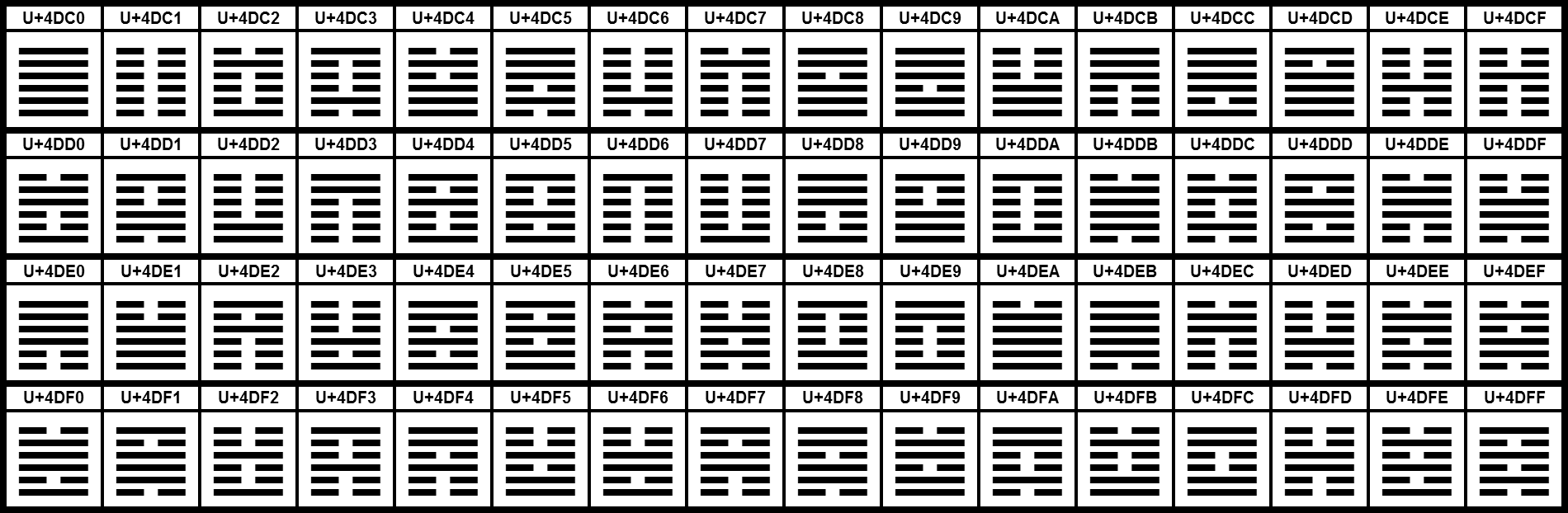
Below the hexagram-level judgments sit the yaoci, line texts assigned to each of the six positions. These are traditionally credited to the Duke of Zhou and offer situational advice keyed to a line's place in the structure — bottom to top, inner trigram to outer. A changing line in the fifth position of one hexagram carries different weight than the same line type in the second position of another. The yaoci turn a static symbol into a narrative arc.
Then come the Ten Wings (Shiyi), a set of commentaries once attributed to Confucius but now dated to the late Warring States period (roughly fourth to third century BCE). The Tuanzhuan explains the hexagram judgments. The Xiangzhuan interprets the trigram images. The Xici zhuan (Great Commentary) elevates the entire system into a cosmological framework, introducing concepts like the supreme ultimate (taiji) and the generative interplay of yin and yang. The Ten Wings transformed what might have remained a divination manual into a philosophical text — and made it required reading for Chinese literati for two millennia.
Methods of Consultation
The oldest surviving method uses fifty yarrow stalks (shi). One stalk is set aside immediately. The remaining forty-nine are divided, counted off, and sorted through a sequence of operations repeated three times to produce a single line. Six lines build a hexagram. The full process for one reading takes roughly twenty minutes of sustained, meditative attention.
What matters philosophically is that the yarrow stalk method does not treat all outcomes equally. The probabilities for the four line types are asymmetric: old yang (a changing solid line, value 9) appears with probability 3 in 16, while old yin (a changing broken line, value 6) appears only 1 in 16. Young yin (8) is the most common outcome at 7 in 16; young yang (7) comes in at 5 in 16. The system is weighted: stable lines tend toward yin, and when change does occur, it is three times more likely to be yang transforming into yin than the reverse. Some scholars read this as encoding a cosmological preference — yang as active and initiating, yin as receptive and completing.
The three-coin method, which became widespread during the Tang dynasty, simplifies everything. Three coins are tossed simultaneously; heads and tails values are summed to determine the line. Each of the four line types has a straightforward probability: 1 in 8 for each changing line, 3 in 8 for each stable line. Old yin and old yang are equally likely. The philosophical asymmetry of the yarrow method vanishes.
Whether this matters depends on what a practitioner believes the consultation is doing. If the process is a ritual technology — a way of synchronizing human attention with cosmic pattern — then the yarrow stalks' asymmetry is a feature, not a bug. If the process is a randomizer whose value lies in the interpretation it provokes, the coins work fine.
Schools of Interpretation
The Confucian reading, dominant from the Han dynasty onward, treats the Yijing as a manual of ethical statecraft. Hexagrams describe situations a ruler or minister might face; the judgments counsel virtuous responses. The junzi (exemplary person) appears throughout the line texts as the implied reader. In this framework, consulting the oracle is an act of moral reflection — not fortune-telling but self-examination under the pressure of decision.
The Daoist reading emphasizes cosmological process. Here the sixty-four hexagrams map the ceaseless cycling of yin and yang, the rhythm of expansion and contraction that governs all phenomena. The trigrams correspond to natural forces — heaven, earth, thunder, water, mountain, wind, fire, lake — and the hexagrams chart their interactions. Later Daoist interpreters folded in wuxing (five phases) theory, correlating hexagrams with wood, fire, earth, metal, and water to construct elaborate systems of correspondence linking the Yijing to medicine, alchemy, and calendar science.
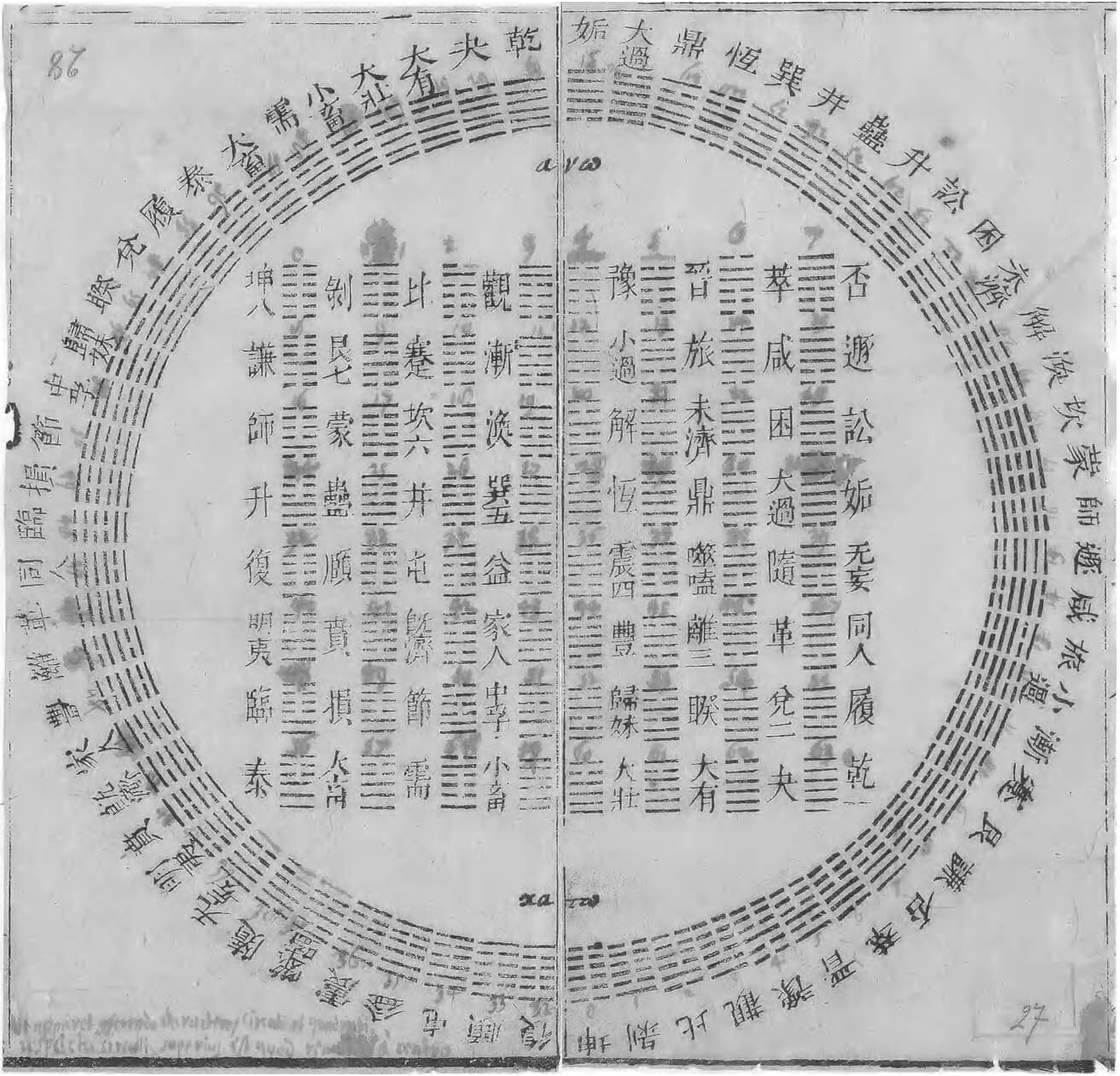
The Song dynasty (960-1279) produced the most technically ambitious school: xiangshu xue, the study of images and numbers. Thinkers like Shao Yong developed intricate numerical arrangements of the hexagrams, including the Xiantian tu (Diagram of the Prior Heaven), which organized all sixty-four hexagrams into a circular and a square pattern based on binary-like sequences. These were not merely decorative. Shao Yong's system proposed that the hexagrams encoded the mathematical structure of cosmic time, with historical epochs corresponding to positions in his numerical schema. The image-number school treated the Yijing less as a text to be read than as a formal system to be computed — a striking anticipation of later mathematical thinking.
Cross-Cultural Adaptation
The Yijing traveled wherever Chinese cultural influence reached, and it changed shape in transit. In Japan, ekigaku (the study of change) became intertwined with Shinto cosmology and later with Edo-period Neo-Confucianism. Korean scholars integrated Yijing principles into their own cosmological frameworks; the national flag of South Korea still bears the taeguk (supreme ultimate) symbol surrounded by four trigrams. Vietnamese divination traditions absorbed Yijing hexagrams into indigenous practices, blending them with local geomancy and spirit-medium traditions.
Western engagement began with a mathematical observation. In 1703, Gottfried Wilhelm Leibniz received a copy of Shao Yong's hexagram sequence from the Jesuit missionary Joachim Bouvet and recognized in it a mapping to binary arithmetic — solid lines as 1, broken lines as 0. Leibniz saw confirmation of his belief in a universal mathematical language, though the parallel was more suggestive than exact.
The twentieth century brought two transformative encounters. Carl Jung's concept of synchronicity — meaningful coincidence without causal connection — drew explicitly on the Yijing as a model for acausal ordering in psychic life. Jung wrote the foreword to Richard Wilhelm's landmark 1950 English translation, framing the oracle as a tool for accessing the collective unconscious. This introduction channeled the Yijing into the streams of Western psychology and, eventually, into the broader current of New Age spirituality.
More recently, a secular philosophical engagement has emerged. Readers approaching the text without metaphysical commitments find in it a sophisticated taxonomy of situational dynamics — a way of thinking about change, timing, and positional advantage that resonates with systems theory and strategic thinking. The Yijing does not require belief in divination to be useful. Its sixty-four hexagrams offer sixty-four framings of how situations develop, peak, and transform — a library of archetypal patterns available to anyone willing to sit with ambiguity.
Further Reading
- I Ching (Wikipedia) — comprehensive overview of the text's history, structure, and cultural significance.
- I Ching Divination — detailed treatment of yarrow stalk, coin toss, and other consultation methods, including probability tables.
- Shao Yong — the Song-dynasty cosmologist whose Xiantian tu arrangements anticipated binary notation.
- Leibniz and the I Ching — how the 1703 correspondence with Joachim Bouvet linked hexagrams to binary arithmetic.
- Carl Jung, Foreword to the I Ching — Jung's introduction of synchronicity through the lens of the oracle.