A Brief History of the I Ching
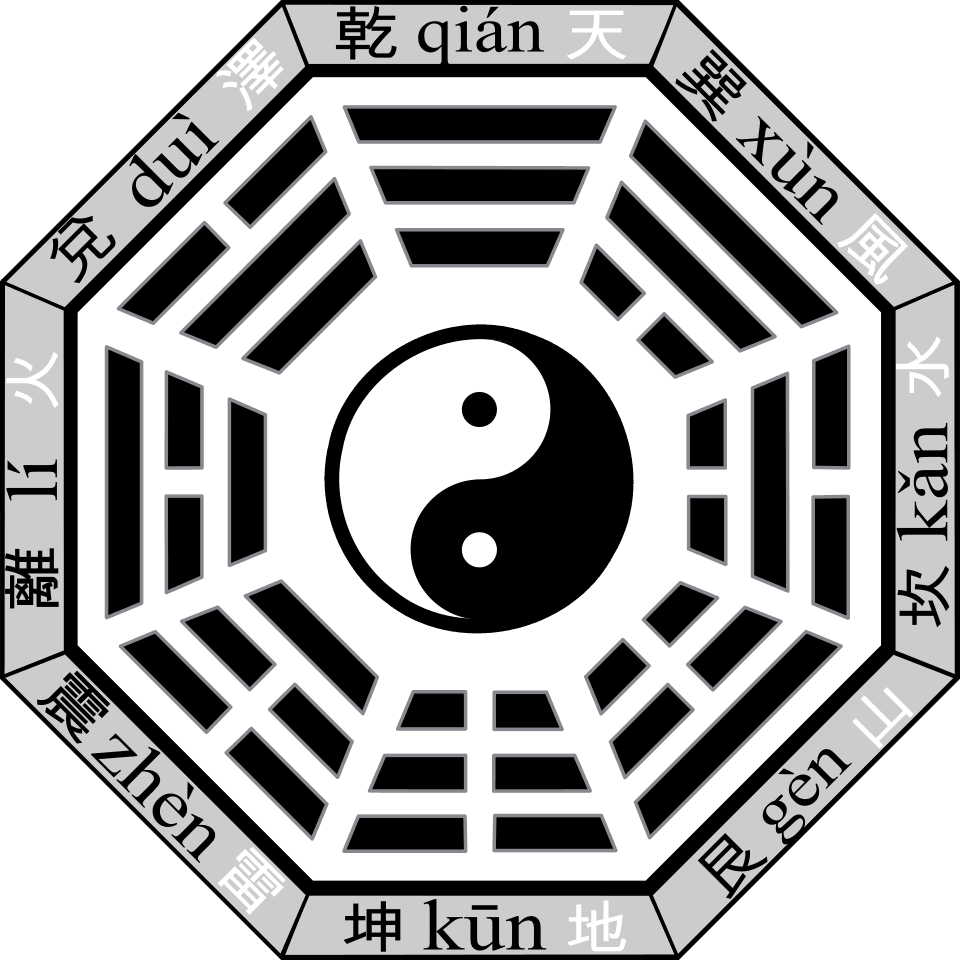
From oracle bones to app stores: three thousand years of the Classic of Changes.
Few books can claim to have shaped philosophy, science, art, and spiritual practice across multiple civilizations over three thousand years. The I Ching — the Classic of Changes, sometimes romanized as Yijing — is one of them. It began as a divination manual in ancient China, became a cornerstone of Confucian philosophy, traveled west through scholarly translation, and landed in the hands of composers, novelists, and counterculture seekers in twentieth-century America. Its core idea is deceptively simple: everything changes, and there is a structure to that change.
What the I Ching Is
At its heart, the I Ching is a system of 64 symbols called hexagrams. Each hexagram is a stack of six horizontal lines, read from bottom to top. The lines come in two types: solid lines, representing yang (the active, bright, firm principle), and broken lines — a solid line with a gap in the center — representing yin (the receptive, dark, yielding principle). Every possible combination of six yin or yang lines produces one of the 64 hexagrams, each carrying a name, a judgment text, and individual meanings for its six lines.
The hexagrams are built from smaller units called trigrams — stacks of three lines. There are eight possible trigrams, each associated with a natural phenomenon: heaven, earth, water, fire, thunder, wind, mountain, and lake. A hexagram pairs two trigrams, creating a relationship between two images. The interpretive tradition reads each hexagram as a snapshot of a situation in flux, with guidance for how to act within it.
The title itself points to the book's central concern. Yi means change or transformation. Jing means classic or scripture. The Classic of Changes is a book about the nature of change itself — how situations arise, develop, reach a peak, and give way to something new.
Legendary Origins
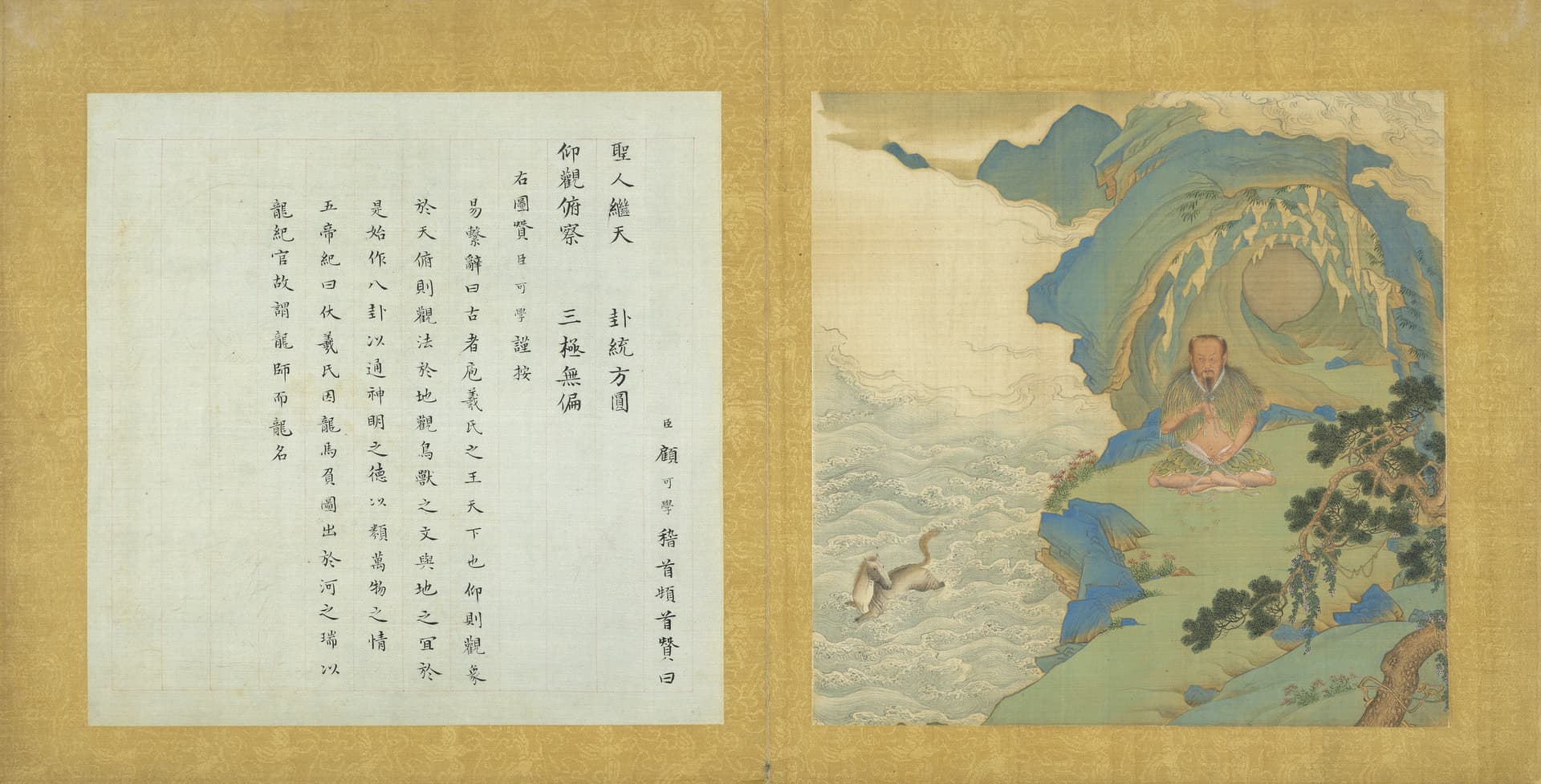
Chinese tradition attributes the I Ching to three legendary figures. The mythical emperor Fu Xi, said to have ruled around the third millennium BCE, is credited with discovering the eight trigrams by observing patterns in nature — the markings on a tortoise shell, the movement of stars, the forms of the landscape. King Wen of Zhou, who lived around the eleventh century BCE, is traditionally credited with arranging the trigrams into 64 hexagrams and composing their judgment texts while imprisoned by the last Shang king. His son, the Duke of Zhou, is credited with writing the line texts that give meaning to each individual line.
Modern scholarship complicates this narrative. The text likely developed over centuries rather than springing from a few named authors, with the earliest layers taking shape during the late Shang and early Zhou dynasties, roughly between 1000 and 750 BCE. Archaeological evidence, including inscriptions on oracle bones, confirms that divination practices involving yin-yang symbolism were deeply embedded in Chinese culture during this period. The legendary attributions reflect the text's cultural authority — a book so important that only sages and kings could have authored it.
From Divination Manual to Confucian Classic
For much of its early history, the I Ching functioned as a divination tool. Practitioners would cast yarrow stalks — or later, coins — to generate a hexagram, then consult the text for guidance. The process was ritualistic, embedded in the religious and political life of the Zhou court.
The transformation from oracle to philosophical text is largely the work of a set of commentaries known as the Ten Wings, or Shi Yi. These ten appendices, traditionally attributed to Confucius, were most likely composed between the fifth and second centuries BCE. The Ten Wings reframed the hexagrams not as tools for fortune-telling but as expressions of cosmic principles — patterns governing nature, society, and moral conduct. The Xici Zhuan (Great Commentary), the most philosophically rich, presents the universe as a dynamic interplay of yin and yang, endlessly generating the ten thousand things of existence.
Whether Confucius actually wrote the Ten Wings is disputed, but the attribution cemented the I Ching's place within the Confucian tradition. It was included among the Five Classics — the foundational texts of Chinese education — and remained central to the imperial examination system for centuries. A manual for casting lots had become one of the pillars of Chinese intellectual life.
Transmission Westward
European encounters with the I Ching began with Jesuit missionaries in China during the seventeenth century. The French Jesuit Joachim Bouvet studied the hexagrams and corresponded with Gottfried Wilhelm Leibniz, who was struck by the resemblance between the hexagram system and his own work on binary arithmetic. Leibniz saw in the arrangement of solid and broken lines a confirmation of his binary notation — the same system of ones and zeros that would eventually underpin digital computing. He published his observations in 1703, explicitly referencing the I Ching. The connection, while more analogical than causal, remains one of the most celebrated intersections of Eastern and Western thought.
The text remained largely inaccessible to Western readers until Richard Wilhelm, a German sinologist who spent over two decades in China, produced a landmark German translation in 1923. Wilhelm's version, informed by years of study with the Chinese scholar Lao Nai-hsuan, was praised for its depth and sensitivity. In 1950, Cary F. Baynes published an English translation of Wilhelm's edition, bringing the text to an enormous new audience. That edition included a foreword by Carl Jung, who used the occasion to introduce his concept of synchronicity — meaningful coincidence as an alternative to strict causality. Jung framed the I Ching as a method for accessing patterns in the unconscious, lending it serious intellectual credibility in the West.
The I Ching in Modern Culture
The Wilhelm-Baynes translation arrived at a propitious moment. By the 1960s, the I Ching had become one of the defining texts of the Western counterculture, embraced alongside Zen Buddhism, the Tao Te Ching, and the writings of Alan Watts. It offered a non-Western framework for understanding experience, resisted dogmatic interpretation, and the act of casting a hexagram felt personal and participatory in a way that reading a static text did not.
Artists and writers found in the I Ching not just a spiritual resource but a creative method. The composer John Cage began using it in 1951 to make compositional decisions, casting hexagrams to determine pitch, duration, and dynamics in works such as Music of Changes. For Cage, the randomness was the point — a way to escape personal taste and let sound organize itself. Philip K. Dick drew on the I Ching while writing The Man in the High Castle (1962), his alternate-history novel in which the Axis powers won World War II. Characters within the novel consult the book, and Dick himself reportedly used it to plot key narrative turns.
Today the I Ching circulates in dozens of translations, from scholarly critical editions to app-based oracle tools. The text has been read through Taoist, Confucian, Buddhist, Jungian, and secular lenses, each tradition finding something recognizable in its structure.
Three millennia after its earliest layers were composed, the Classic of Changes endures — not because it predicts the future, but because it offers a language for sitting with uncertainty. In a book built entirely on the principle that nothing stays the same, that persistence is perhaps the most fitting paradox of all.
Further Reading
- I Ching — Wikipedia — Comprehensive overview of the text's history, structure, and cultural influence.
- Richard Wilhelm's I Ching Translation — Background on the landmark translation that brought the I Ching to Western audiences.
- John Cage and Chance Operations — How Cage used the I Ching to compose Music of Changes and reshape twentieth-century music.
- Philip K. Dick, The Man in the High Castle — The alternate-history novel in which the I Ching plays a central narrative role.
- Leibniz and Binary Arithmetic — The celebrated connection between hexagram notation and the binary system.