The I Ching: Origins, Commentarial Tradition, and Scholarly Debate
How archaeology and textual criticism dismantled the myth of a single ancient author — and revealed something far more interesting.
The Yijing has been treated as a single, ancient book for so long that it takes deliberate effort to see it as what it actually is: a composite text assembled across centuries, shaped by political agendas, philosophical movements, and the accidents of manuscript transmission. The traditional story — King Wen composed the hexagram judgments in prison, the Duke of Zhou added the line texts, Confucius wrote the commentaries — is elegant and almost certainly wrong. What archaeology and textual criticism have revealed is more interesting: a text whose layers can be dated, whose sources can be traced, and whose canonization was neither inevitable nor straightforward.
Archaeological Context: Before the Hexagrams
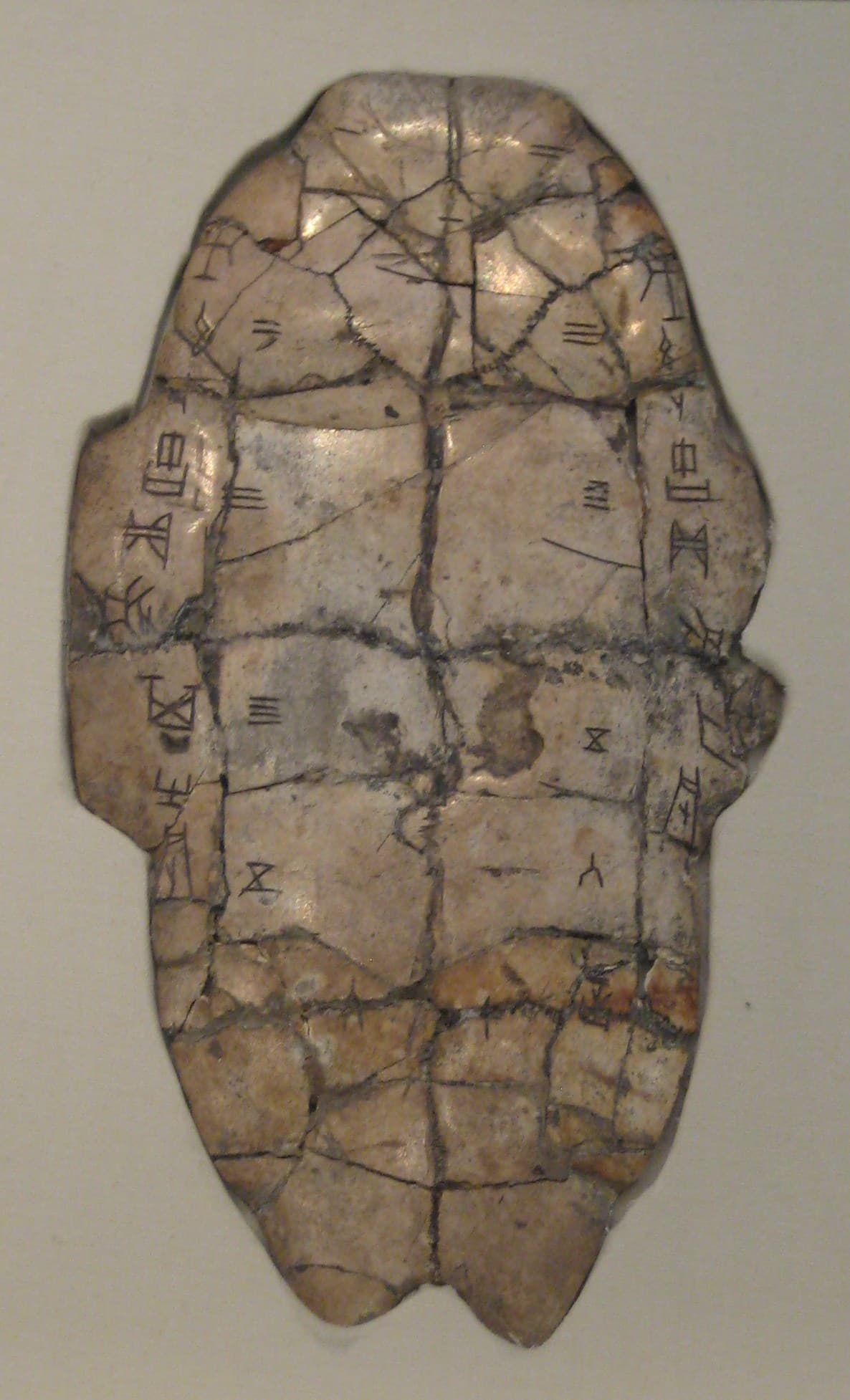
Long before anyone stacked six lines into a hexagram, divination in China meant burning bones. Shang dynasty practitioners (roughly 1600-1046 BCE) performed bu, pyromantic divination using animal scapulae and turtle plastrons (oracle bones). The diviner carved pits into the bone or shell, applied a heated brand, and interpreted the resulting crack patterns as responses from ancestral spirits or the high god Di. Tens of thousands of these oracle bones survive, excavated primarily from the Shang capital at Yinxu near modern Anyang. Their inscriptions reveal a divination culture that was systematic, bureaucratic, and embedded in royal governance. But they have nothing to do with hexagrams.
The leap from interpreting heat-induced cracks to manipulating yarrow stalks and constructing binary line figures represents a fundamental shift — from reading signs imposed by spirits to generating structured symbols through a quasi-random procedure. The transition remains poorly documented. Western Zhou bronze inscriptions (1046-771 BCE) contain scattered references to yi (change) that may indicate early hexagram divination, but the evidence is fragmentary. By the late Western Zhou, milfoil divination (shi) was in use alongside the older methods. The Zuozhuan, covering events from roughly 722 to 468 BCE, records multiple Yijing consultations, quoting texts recognizable from the received version.
Textual Stratification: Who Wrote What, and When?
The core text of the Yijing — hexagram judgments (guaci) and line texts (yaoci) — did not arrive as a single composition. The question of when each layer was written has occupied scholars for decades, and no consensus is fully settled.
The hexagram judgments are generally dated to the Western Zhou period, roughly the tenth or ninth century BCE. Edward Shaughnessy, in his philological work at the University of Chicago, has argued for this date based on vocabulary, syntax, and historical allusions within the guaci. The language shares features with Western Zhou bronze inscriptions and differs markedly from later Warring States prose; certain judgments appear to reference specific military campaigns of the early Zhou court.
The line texts present a harder problem. Some scholars place them alongside the hexagram judgments as a single Western Zhou stratum. Others, noting stylistic variations and apparent anachronisms, have proposed that portions of the yaoci date to the Spring and Autumn or early Warring States period (fifth to fourth century BCE). The texts are terse and imagistic enough to resist firm linguistic dating. Attributing the judgments to King Wen and the line texts to the Duke of Zhou — the traditional account — is best understood as a legitimizing narrative rather than a historical claim.
The Ten Wings and Canonization
The Ten Wings (Shiyi) are seven distinct commentaries (some divided into two parts, yielding ten sections) that were appended to the base text and came to be treated as integral to it. Tradition credits Confucius with their authorship. This attribution was questioned as early as the Song dynasty by Ouyang Xiu, who noted stylistic inconsistencies among the Wings and between the Wings and the Lunyu (Analects). Modern scholarship has confirmed his suspicion: the Ten Wings are the work of multiple hands spanning the fourth through second centuries BCE.
The Xici zhuan (Great Commentary), the most philosophically ambitious of the Wings, introduces the cosmological vocabulary — taiji (supreme ultimate), yin and yang as cosmic principles, the generative process of the four images and eight trigrams — that would define the Yijing's reception for two millennia. Its language and concepts align with late Warring States and early Han intellectual currents, not with the historical Confucius of the fifth century BCE.
The incorporation of the Yijing into the Five Classics (Wujing) canon during the early Han dynasty cemented its dual status as divination manual and philosophical treatise. The Han court established official academicians (boshi) for each Classic, institutionalizing interpretation and ensuring that the Yijing — now packaged with its Wings — would be studied as a unified, authoritative text.
The Mawangdui Manuscript
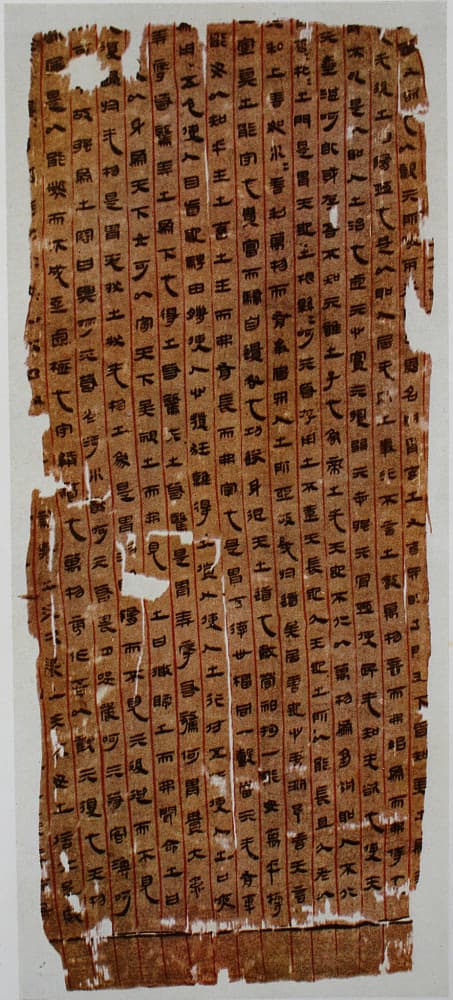
In 1973, excavations at Mawangdui near Changsha, Hunan province, opened a tomb sealed in 168 BCE. Among the silk manuscripts found inside was a copy of the Yijing that predates the received text tradition by centuries of editorial standardization.
The Mawangdui manuscript diverges from the standard version in two striking ways. First, the hexagram sequence differs entirely from the received King Wen ordering. The Mawangdui text arranges hexagrams by upper trigram — a systematic, taxonomic principle quite different from the paired-hexagram logic of the received sequence. This demonstrated that the King Wen ordering, long treated as ancient and cosmologically significant, was one arrangement among several in circulation during the early Han.
Second, the manuscript contains numerous variant readings. Some are trivial graphic substitutions, but others affect meaning substantially. Edward Shaughnessy's 1996 study, I Ching: The Classic of Changes (the first complete English translation of the Mawangdui version), catalogued these variants and argued that they reveal a text still in flux during the second century BCE, not yet fixed by the editorial authority that would later produce a single standard version. The manuscript also included previously unknown commentarial texts, suggesting that the commentarial tradition was richer and more varied than the Ten Wings alone would indicate.
Key Scholarly Debates
The study of the Yijing as a historical document rather than a sacred text is relatively recent, and several debates remain active. Shaughnessy's philological approach — treating the guaci as historical documents datable by their language — has been foundational, though not all scholars accept his specific chronological arguments.
Richard Rutt, in his 1996 study Zhouyi: The Book of Changes, brought an anthropological lens to the text, drawing comparisons with divination practices across cultures and emphasizing the Yijing's origins in a ritual context distant from the philosophical framework imposed by later commentators. Rutt argued that the hexagram judgments and line texts are better understood as products of a scribal-divinatory milieu than as proto-philosophy.
Kidder Smith, along with collaborators Peter Bol, Joseph Adler, and Don Wyatt, examined the commentarial tradition itself as an object of study in Sung Dynasty Uses of the I Ching (1990), tracing how successive interpreters reshaped the text's meaning to serve their own intellectual projects. This approach treats the Yijing not as a book with a fixed meaning to be recovered but as a living document whose significance is constituted by its interpretive history.
The current state of the field reflects a productive tension between philological reconstruction and reception history. Neither approach alone captures what the Yijing is. The manuscript evidence continues to grow: excavated texts from Guodian and Shanghai Museum bamboo strips promise to further complicate the picture, pushing the hexagram tradition deeper into the past while revealing just how many versions of the book once existed.
Further Reading
- Edward L. Shaughnessy, I Ching: The Classic of Changes (Ballantine, 1996) — the first complete English translation of the Mawangdui manuscript, with extensive philological commentary on variant readings.
- Richard Rutt, Zhouyi: The Book of Changes (Routledge, 1996) — an anthropological study situating the hexagram texts in their original divinatory context, with a fresh translation of the base text.
- Kidder Smith, Peter K. Bol, Joseph A. Adler, and Don J. Wyatt, Sung Dynasty Uses of the I Ching (Princeton, 1990) — a study of how Song-era commentators transformed the text's meaning through successive reinterpretation.
- Wikipedia, "I Ching" — a broad overview of the text's history, structure, and cultural influence, with useful links to primary scholarship.
- Wikipedia, "Oracle Bone" — background on Shang dynasty pyromantic divination and the archaeological discoveries at Yinxu that provide the Yijing's deep prehistory.